Account Types
Budget Thing has eight account types. The type you choose affects how the account is classified in net worth and, for cards and loans, how transfers and payments to it are handled. It never turns budgeting off for an account — see Budget vs. Tracking Accounts.
How the types are grouped
When you add or edit an account, the Account type list groups the types under headings so the right one is easy to find:
| Group | Account types |
|---|---|
| Cash & Bank | Checking, Savings, Cash, Digital Wallet |
| Credit Cards | Credit Card |
| Investments | Investment |
| Loans & Liabilities | Liability |
| Other Assets | Asset |
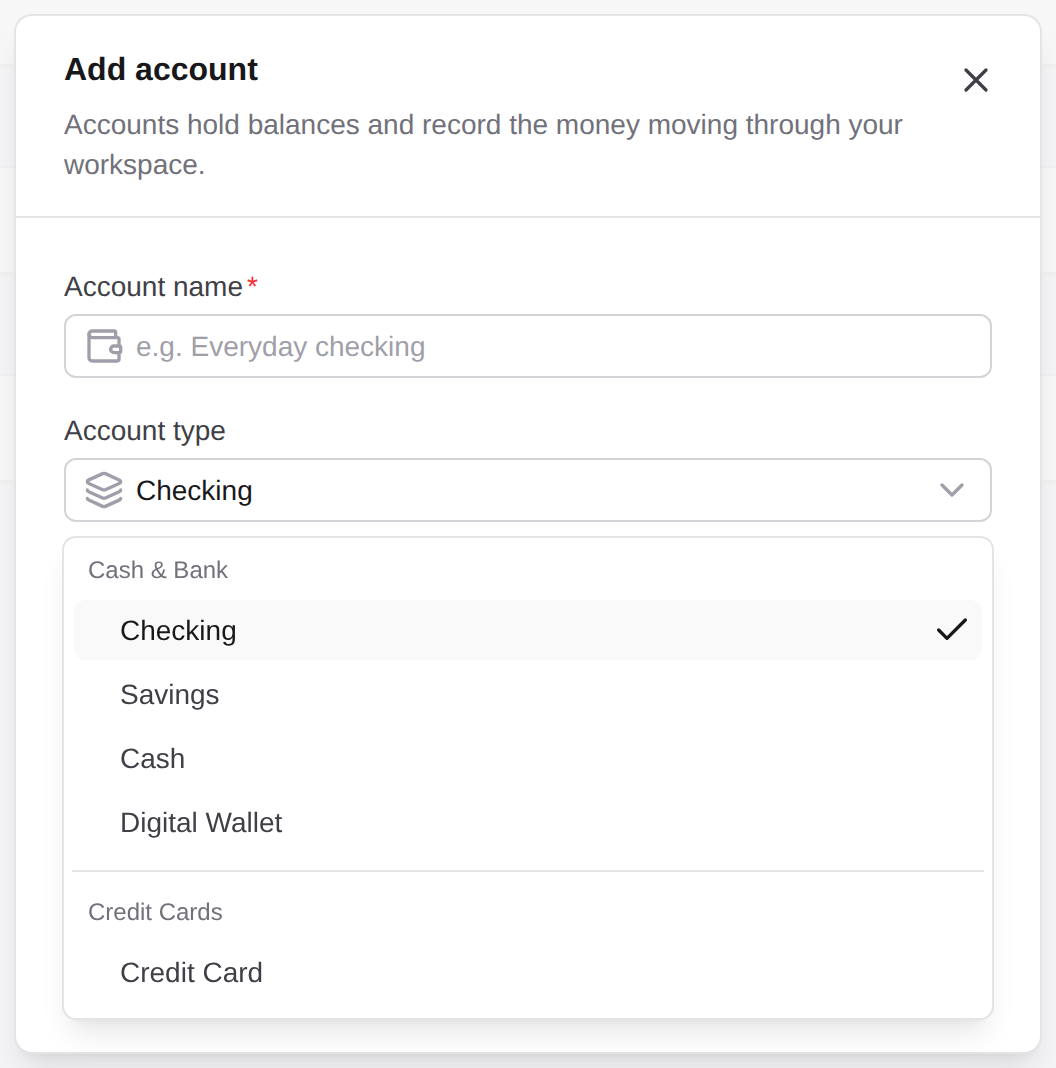
The groups are only there to help you choose. What an account does is decided by its type.
Checking
Your everyday account: pay goes in, spending comes out. Its balance counts as an asset in net worth. Most people have one or two, and this is where the majority of transactions live.
If you are not sure which type fits a cash-like account, Checking is the safe answer.
Savings
Money you are holding back for later. It behaves exactly like Checking — the balance is still yours to assign to categories — but keeping it separate makes it obvious when you dip into it.
Moving money between checking and savings is a transfer, not spending, so it does not change what you have assigned to your categories.
Cash
Physical money on hand — a wallet, a petty-cash tin, a cash envelope. It behaves like Checking: the balance is an asset and yours to budget.
Digital Wallet
A balance held with a payment service such as PayPal, Venmo or Cash App. It also behaves like Checking: the balance counts as an asset, and you can spend from it, transfer from it, or pay a credit card from it.
Credit Card
A card you spend on now and pay off later. The balance is what you owe, so it counts against your net worth rather than for it.
Adding a credit-card account also creates a payment category named after the account — for example Visa Payment — inside the Credit Card Payments group. The account shows a Ready to pay figure, which is the money your budget has already set aside for the card.
The card account's main button is Make Payment. Paying the card from a Cash & Bank, Asset or Investment account is recorded as a payment against the card's payment category. Moving a balance from one credit card to another is a plain transfer and uses no category. Drawing cash from the card into a Cash & Bank account (a cash advance) adds spendable money to your budget, so it requires a category you choose.
The whole mechanism is explained in The Payment Category; start with Credit Cards if cards are new to you here.
Asset
Something you own that has value but that you do not spend from day to day: a house, a car, a valuable instrument. Its balance adds to your net worth.
Asset accounts usually see very few transactions — an opening balance, then an occasional adjustment when the value changes.
Liability
Something you owe that is not a credit card: a car loan, a mortgage, a personal debt. The balance is what remains outstanding, and it counts against your net worth.
Payments to a liability account are transfers from the account you pay with, not new spending, and you choose the category the money comes from. A liability account has no payment category of its own, but like a credit card its main button is Make Payment. Moving debt from one liability account to another uses no category. Drawing money out of a loan into a Cash & Bank account (a drawdown) adds spendable money to your budget, so it requires a category you choose. See Loan Accounts and Loan Payments.
Investment
Holdings whose value you want reflected in your net worth — a brokerage account, a pension, a fund. The balance adds to net worth like an asset.
Budget Thing tracks the account's value, not individual holdings or share prices. Record what the account is worth on a given day, separately from the money you put in, so net worth reflects the market value and you can see growth. See Track an Investment Account.
How the type affects transfers
Whether a transfer asks for a category depends on the types of both accounts:
| Moving money or debt | Category |
|---|---|
| Between two Cash & Bank, Asset or Investment accounts | None |
| From a Credit Card or Liability into a Cash & Bank, Asset or Investment account (a cash advance or loan drawdown) | Required — you choose it |
| From a Cash & Bank, Asset or Investment account into a Credit Card (a card payment) | The card's payment category, filled in for you |
| From a Cash & Bank, Asset or Investment account into a Liability | Required — you choose it |
| Credit Card to Credit Card, or Liability to Liability | None |
| Credit Card to Liability, or Liability to Credit Card | Required — you choose it |
See Transfers for what each case means.